


How to fit a fuel stop solenoid: linkage, wiring and first start checks
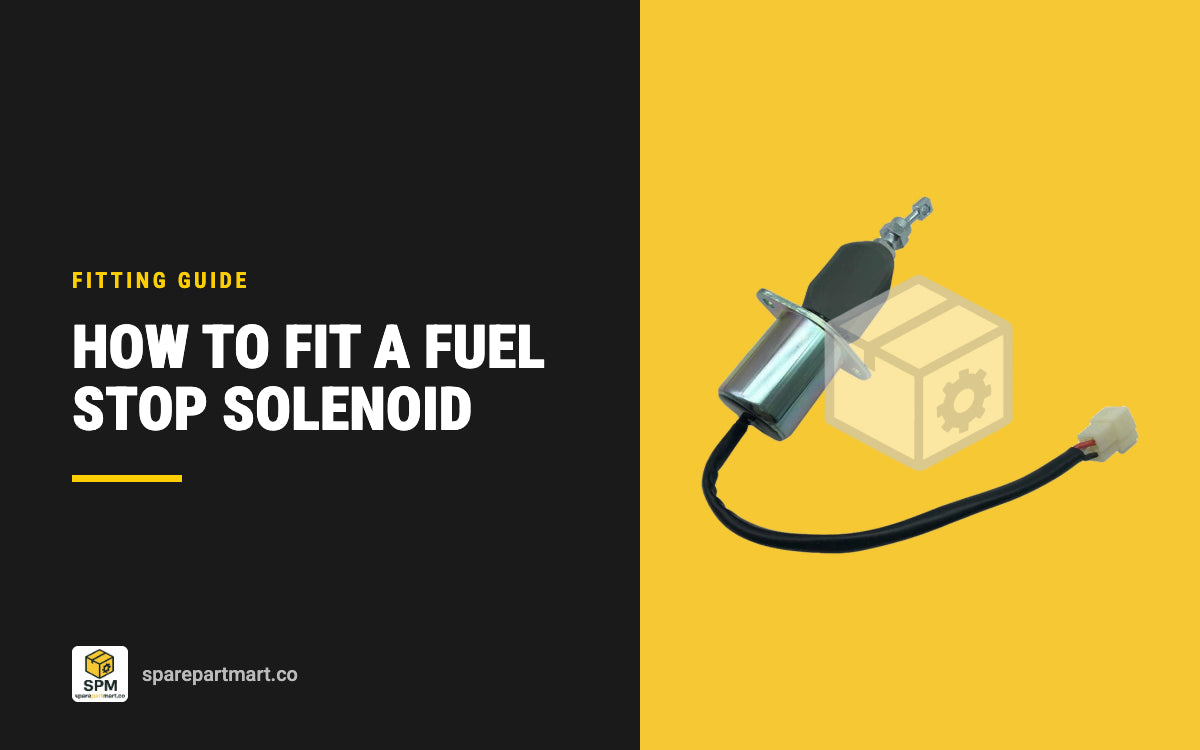
To fit a fuel stop solenoid, match the part number and voltage, disconnect the battery, and mount the new unit so the plunger can travel all the way in. If the solenoid works a lever, set the linkage with only the hold coil powered. Then wire the pull coil so it only gets power while the key is in START, and make the first start in short cranks. Most early failures come from a short linkage, a pull coil left powered, or overcranking. This guide covers each step for the two kinds we see most, the bolt-in Kubota style and the bracket-mounted Woodward 1500, 1751 and 1756 style.
Which kind of stop solenoid you have
Of the 489 live products in our Solenoid range, 429 are fuel stop, shutoff or shutdown solenoids. Woodward (73), Cummins (70), Kubota (38), Caterpillar (25) and Deutz (23) part numbers make up most of the stop solenoids. Where the title states a voltage, 192 are 12 V and 109 are 24 V.
Before you take anything off, check four things on the old unit:
- Voltage. A 12 V solenoid on a 24 V machine burns out, and a 24 V unit on 12 V will not pull in. Woodward puts the voltage first in the part number: 1751ES-12... is 12 V, 1751ES-24... is 24 V.
- Two terminals or three wires. A two terminal unit is internally switched: a contact inside cuts the pull coil when the plunger bottoms. A three wire unit is externally switched: the key switch or a timer cuts the pull coil.
- Pull or push. A pull type draws its plunger in when powered, a push type pushes it out.
- Energized to run or to stop. Most machines are energized to run: power holds the fuel on.
The Kubota 17520-60012 (12 V, used on V2203, D722, D905, D902 and Z482 engines, see current price) bolts into the engine. The Kubota SA-4572-12-T is a 1751ES style unit with a two hole flange, a rubber boot over the plunger and a three wire lead to a white plug. If your old one carries a different number, search it on our compatibility page before ordering.
Bench test the new solenoid before you fit it
Check the coils before you fit the solenoid. Kubota's 05 series workshop manual gives this method:
- Connect the solenoid body to battery negative.
- Put a switch between battery positive and the pull coil terminal (P), and another between battery positive and the hold coil terminal (H).
- Close the pull switch: the plunger pulls in. Open it: the plunger comes back out.
- Close the hold switch, then close and open the pull switch: the plunger pulls in and stays in on the hold coil alone.
Kubota's rule is never to power the pull coil for more than two seconds during this test. On a three wire Woodward unit the pull coil is white to black and the hold coil is red to black.
You can also check the coils with an ohmmeter at about 21 °C. Kubota gives about 0.38 ohm for the pull coil and about 16 ohm for the hold coil on its 05 series solenoid. Woodward lists 0.232 to 0.284 ohm (pull) and 9.82 to 12.00 ohm (hold) for a 12 V 1751ES, and 0.878 to 1.073 ohm and 46.55 to 56.89 ohm for the 24 V version.
Fitting a bolt-in solenoid
On Kubota engines like the V2203 and D905, the stop solenoid bolts into the engine, and its plunger works the fuel control inside. The workshop manual lists the stop solenoid as the first part off for several injection pump jobs, so expect to take it out and refit it more than once in an engine's life.
- Disconnect the battery, unplug the connector, remove the mounting bolts and draw the old solenoid out straight.
- Clean the joint face. If the speed control plate also came off, Kubota calls for a liquid gasket (Three Bond 1215 or equivalent) on both sides of the solenoid cover gasket and the control plate gasket. Take care not to drop the governor spring into the crankcase.
- On engines with a boost compensator (Kubota's R24 models), the stop solenoid's M6 x 87 mm mounting bolt also locates the compensator, so follow the manual's order when you take it apart and put it back together.
- Seat the new solenoid squarely, tighten the bolts evenly and plug it in.
A bolt-in unit has no swivel to adjust. If it is the right part, the engine sets the stroke.
Fitting a bracket-mounted solenoid and setting the linkage

Woodward 1500, 1751, 1753 and 1756 style solenoids sit on a bracket and pull an outside fuel lever through a threaded swivel. This is where most fitting mistakes happen. Woodward's Kubota kit manual (36709) and troubleshooting guide (36541) give the procedure:
- Mount it the right way round. The boot's cable tie clamp faces down and away from the bracket.
- Hook up the swivel and bolt the solenoid down, then fit and spread the cotter pin.
- Power the hold coil only. On a three wire unit, connect red and black to a battery or a supply of 1 A or more, and push the plunger in by hand until it holds. Do not power the white wire. On a two terminal unit, power the terminals and let the plunger pull fully in. Once it bottoms, only the hold coil is on.
- Turn the swivel until the fuel lever sits within 1.6 mm (1/16 in) of full run with the plunger bottomed.
- Lock it with the jam nut tight against the plunger.
- Power off and move the lever by hand. It must move freely from stop to run, and the spring must bring it back to stop.
If the linkage is too short, the plunger cannot bottom. A two terminal solenoid then never trips its internal switch, so the pull coil stays on and burns out. A three wire solenoid instead drops out, and the engine dies when you let go of the key. On a push type, the fault is the reverse: the linkage is too long.
Two common examples in our range are the Woodward 1751ES-12E2ULB1S1 (three wire, 12 V) and the Woodward 1751-12E7U1B1S1 (two terminal, internally switched). Woodward rates the 1751 and 1753 family at 85 to 111 N (19 to 25 lb) of pull and 169 to 191 N (38 to 43 lb) of hold.
Wiring it so the pull coil cannot cook

The pull coil draws 30 to 50 A, depending on the model, while the hold coil draws typically 1.2 A. The hold coil can stay on for as long as the engine runs. The pull coil is only meant to be on for the moment it takes to pull the plunger in.
- Three wire units: red (hold) to a feed that is live in both RUN and START, white (pull) to a feed that is live only in START, and black (common) to ground. Some solenoids use other colours, so read the label.
- Never take the pull coil feed from the starter's S terminal, or from the relay that feeds it. Woodward says doing this voids its warranty.
- Use a timer if the machine is unattended or remote started. Woodward's pull coil timer cuts the pull coil about 1.5 seconds after it is energized, which protects it from overcranking.
- Relays in the circuit should be rated for at least 60 A.
Before the first start, put a meter across the pull and common wires with the key in RUN. It must read zero. Any voltage there means the pull coil will stay on, so unplug the solenoid and trace the wiring before going further.
First start checks
- Voltage while cranking. Woodward's minimum at the solenoid is 75% of rated: 10 V on a 12 V system and 20 V on a 24 V system, measured at both the pull and hold wires. Below that, the plunger may not pull in, or it may drop out when you release the key.
- Watch it work. With one person on the key and one at the engine, cycle the key a few times. The lever should travel fully from stop to run and return to stop when the key goes off.
- Crank in short bursts. Woodward's limit is three 30 second cranks with two minutes of rest between each. After three attempts, let the solenoid cool to air temperature before you try again. Overcranking is the usual reason a three wire solenoid burns out.
- Start and stop it. The engine should stop every time the key goes off. If it keeps running, check for voltage on the hold wire with the key off. Woodward notes that an alternator circuit feeding back through the hold coil can do this.
If the solenoid moves the lever but the engine still will not start, look at fuel, the injection pump, filters and grounds. Our fuel injection pump fitting guide covers bleeding a Kubota after fuel work.
Mistakes that shorten a new solenoid's life
- A torn or missing boot. Dirt gets in and drags on the plunger.
- Loose mounting bolts. The solenoid sits out of line and loses force.
- Low voltage or poor grounds. The plunger never bottoms and the coil overheats. Too much voltage overheats it too.
- A hot or wet spot. Heat, standing fluid and dust all shorten its life.
If you cannot find your number, or the old unit's label is unreadable, send a photo through our quote request page and we will match it. The full range is in heavy equipment solenoids and valves.
Frequently asked questions
Do I have to adjust a bolt-in Kubota stop solenoid?
No. Units like the Kubota 17520-60012 bolt straight into the engine and have no swivel. Use the correct gasket and sealant, then bench test the unit and check that the engine starts and stops.
Why does my engine start, then stop as soon as I let go of the key?
The hold coil is not keeping the plunger in. Check for at least 10 V (12 V systems) or 20 V (24 V systems) on the hold wire in RUN. Then check the linkage length: if the plunger cannot bottom, the hold coil cannot keep it in.
Is a starter solenoid the same part?
No. A starter solenoid, such as the Bobcat 6680376, switches current to the starter motor. It does not touch the fuel. If the engine will not crank at all, start with our guide to bad starter motor signs.
How long can the pull coil be powered?
Only while cranking. Kubota's bench test limit is two seconds, Woodward's timer cuts it at about 1.5 seconds, and cranking should stay within three 30 second attempts with two minutes of rest between each.
