


Cheap plasma consumables: is there a difference in quality?
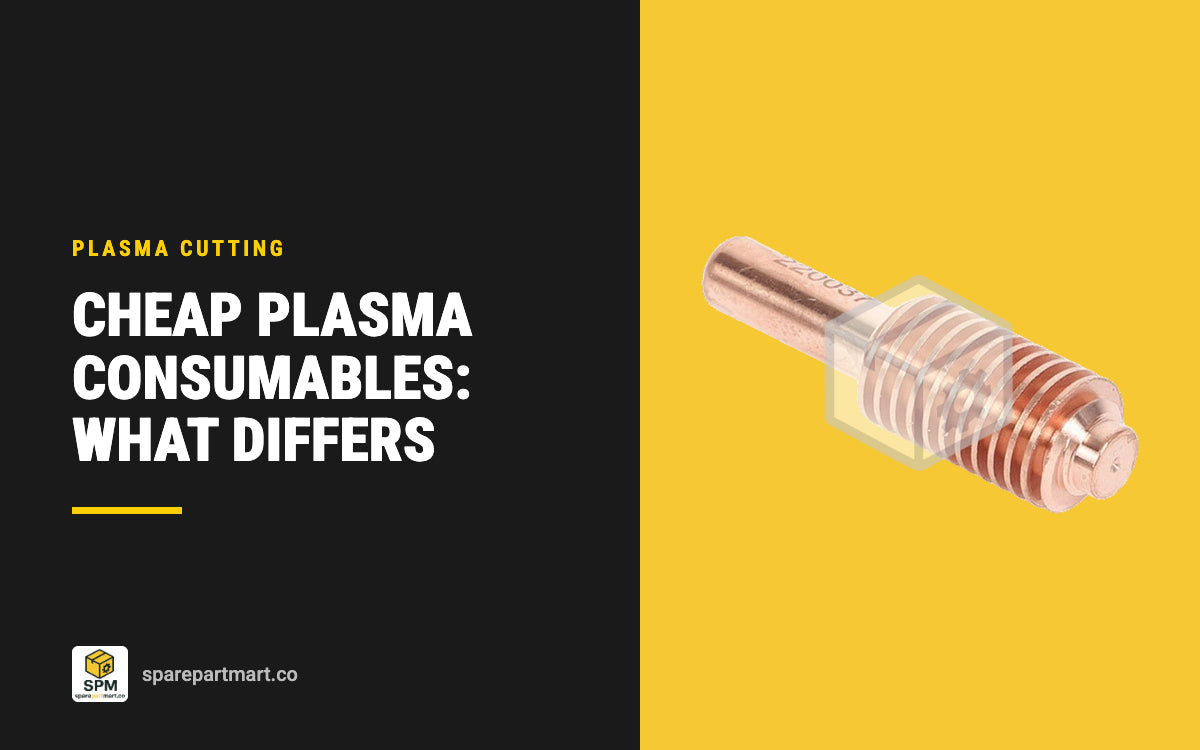
Yes, there is a difference in quality between plasma consumables, but price does not tell you which side of it a pack is on. What separates a good electrode or nozzle from a bad one is a handful of things you can check: a hafnium insert centred in the electrode tip, a nozzle orifice that is perfectly round with sharp edges, swirl ring gas holes that are all open, and the right part for your torch and amperage. A cheap part that passes those checks cuts like any other. A part that fails them wears out fast and can take the torch with it, whatever it cost. The only fair test after that is to count starts and arc time on your own machine.
This guide covers what to look at on a new pack, how long plasma consumables last, how to tell when each one is finished, and what a burnt electrode is telling you. The wear limits come from Hypertherm's published consumable care guidance; the part details come from the 52 plasma consumables we list for Hypertherm, Thermal Dynamics, Trafimet and Miller torches.
What actually differs between a good and a bad consumable
Every air plasma stack does the same jobs. The electrode carries the current and gives the arc a place to start: a copper body with a small insert of hafnium (or tungsten) pressed into the tip, because the arc attachment point has to survive far more heat than copper can. The swirl ring spins the gas so the arc stays centred on the electrode and through the nozzle. The nozzle shapes and squeezes the arc, and its orifice size is set for one current. The shield or retaining cap holds the stack together and protects the nozzle from spatter.
Quality problems show up in exactly those functions:
- The insert. If the hafnium sits off centre, or is not seated firmly in the copper, the arc cannot start from the centre of the electrode, which is where the swirl ring is built to hold it.
- The orifice. Hypertherm describes a new nozzle as having a perfectly round orifice with sharp inside and outside edges. Any change in that shape affects cut quality, so a bore that is oval or burred when new starts out where a worn nozzle ends.
- The swirl holes. The small angled holes have to be open, evenly spaced and the right size. Blocked or misdrilled holes shorten electrode and nozzle life.
- Fit. Length, tip shape and thread have to match the torch so the gap between electrode and nozzle is right. Hypertherm names mismatched parts as the most common thing that damages nozzles.
None of those can be judged from a price tag or a photo. All of them can be judged in two minutes with the part in your hand.
How to check a new pack before it goes in the torch

Take one piece out of each new pack and put it next to a worn part you know came off your torch.
- Electrode: the part number marked on the body, the same overall length and tip shape as your old one, the insert visibly centred in the tip, a flat face with no pit, and clean threads.
- Nozzle: the amperage marked on it matches the job. Hold it up to the light or use a jeweller's loupe: the hole should be a clean circle with sharp edges and no nicks inside.
- Swirl ring: every gas hole open, no chips or cracks, o-rings seated and not cut. Ceramic swirl rings crack if dropped, so check one that has been rattling around a toolbox.
- Shield and retaining cap: a round main orifice, clear vent holes and clean, full threads.
Nozzles are the part most often fitted wrong, because they look alike across currents. On the Powermax1000, 1250 and 1650 T60 and T80 torches, the 40 A, 60 A and 80 A nozzles share the same electrode, the Hypertherm 120926 electrode, but each nozzle is made for its own current. The Thermal Dynamics SL60 and SL100 work the same way: one 9-8215 electrode (currently see current price for a 10 pack) covers 30 to 120 A, and the tips run from the 30 A 9-8206 drag tip up to the 120 A 9-8253. Hypertherm lists amperage set too high for the nozzle among the causes of nozzle damage, so match the tip to the current you set.
What is the life span of plasma consumables?
Hypertherm gives normal life for air and oxygen plasma electrodes as 1 to 2 hours of arc-on time and several hundred pierces, with well set up systems reaching 1,000 or more starts. Starts matter more than minutes: most electrode wear happens when the arc strikes and when it stops, as the hafnium surface melts and freezes again. A shop cutting long straight lines in thin sheet gets far more life from a set than one cutting small parts with a pierce every few seconds.
The swirl ring, shield and retaining cap last much longer. Hypertherm's guidance is that a swirl ring treated properly lasts through several electrode and nozzle changes, and the outer retaining cap through several sets.
This is also where cheap and expensive consumables should be compared, because claims on a packet prove nothing. Hypertherm recommends logging the number of starts and arc-on time for every change, and comparing only jobs of the same metal thickness, amperage and cut length. Do that for two sets of each brand and you have a real answer for your machine.
How to tell when plasma consumables need replacing

The electrode decides. As it is used, the hafnium erodes into a small round pit in the centre of the tip. Measure the pit depth with a dial depth gauge, and change the electrode at:
- 1 mm (0.040 in) for a standard copper electrode, which is Hypertherm's figure for most of its systems.
- 2 mm (0.080 in) for a silver electrode.
- No deeper than 1.6 mm (1/16 in) on Hypertherm Powermax torches, from Hypertherm's Powermax maintenance guidance.
Your torch manual's figure comes first where it gives one. Change the nozzle at the same time: Hypertherm recommends replacing the nozzle and electrode as a set, and inspecting them as a pair because they wear together. Replace a nozzle on its own if the orifice is nicked or notched, oval, or its edges have gone round.
For the other parts:
- Swirl ring: replace it if it is cracked, worn or a gas hole is deformed or blocked.
- Shield: dross around the orifice means the torch pierced too close to the plate. Brush it off; if the orifice is still perfectly round the shield stays in, and if not it is replaced.
- Retaining cap: replace it if it is burnt or cracked, or the threads are damaged. Screw it on finger tight; Hypertherm warns that overtightening crushes the swirl ring.
In use, the sign is falling cut quality. Hypertherm notes that excessive electrode wear reduces cut quality and raises the risk of an electrode failure that damages the other consumables and the torch. When cuts get worse, check the pit before blaming the machine.
What happened to my plasma cutter electrode?
An electrode that has burnt out, with a deep crater and melted or discoloured copper around the tip, was run past the end of its insert. Hypertherm's explanation: once the pit gets too deep, the arc attaches to the copper holder instead of the hafnium and melts it. Molten copper blown out of the electrode then lands inside the nozzle, so both parts are finished, and a set run that far can damage the torch. Measuring the pit and changing at the limit prevents it.
Other electrode patterns point at a cause outside the part:
- Pock marks across the face, with matching damage inside the nozzle: gas flow too low.
- Black residue on the electrode: the plasma gas is contaminated, usually by water or oil from the compressed air. Drain the filter bowl and check the dryer.
- A deep but even pit with a nozzle that still looks good: plasma gas flow set too high.
- Nozzle damaged on the outside: piercing too low. Hypertherm calls this the number one cause of early nozzle failure and gives pierce height as twice the cut height.
Hypertherm's list of what wears electrodes early adds mismatched torch parts, kinked or split gas hoses, and moisture in the air. Fix those first; a new set of consumables will only fail the same way.
Aftermarket consumables for Hypertherm and other torches
Aftermarket consumables are made to the original part number and fit, and the same checks above apply to them as to any other part. We list aftermarket sets only for established torch families: the Hypertherm Powermax1000, 1250 and 1650 with T60, T80 and T100 torches, the MAX200 and HT2000, the Thermal Dynamics SL60 and SL100, the Trafimet S45, A101 and S105, and the Miller ICE 40C and 55C. Each listing carries the original part number, the torch it fits and the amperage it is made for. For current Powermax45 to 125 torches we do not list aftermarket parts.
For the T100 on a Powermax1650, the set is the 220037 electrode and 220011 nozzle, both 100 A, with the 220051 swirl ring lasting across several sets. The full range by torch is in plasma consumables. If your torch is not listed, send the part numbers off your old parts through request a quote, or check fit on our compatibility page.
Frequently asked questions
Are cheap plasma consumables worth it?
They are when they pass the checks: right part number and amperage, a centred hafnium insert, a round sharp-edged nozzle orifice and open swirl holes. Log starts and arc-on time for two sets and compare them on the same job; that tells you more than any price difference.
How long do plasma cutter consumables last?
Hypertherm gives 1 to 2 hours of arc-on time and several hundred pierces as normal for air and oxygen plasma, with good setups passing 1,000 starts. Many short cuts use them up faster than a few long ones.
Should I change the nozzle and electrode together?
Yes. They wear as a pair, and a worn electrode spoils the nozzle and the other way round. Hypertherm recommends changing them as a set.
How deep can the electrode pit go?
About 1 mm (0.040 in) for a standard copper electrode on most Hypertherm systems, 2 mm (0.080 in) for a silver electrode, and no more than 1.6 mm (1/16 in) on Powermax torches. Use your torch manual's figure where it gives one.
Why do my consumables wear out so fast?
The usual causes are the wrong nozzle for the amperage, piercing too close to the plate, wet or oily air, wrong gas pressure and running electrodes past their pit limit. Check those before changing brands.
