


What is a filter element? Hydraulic filter elements explained
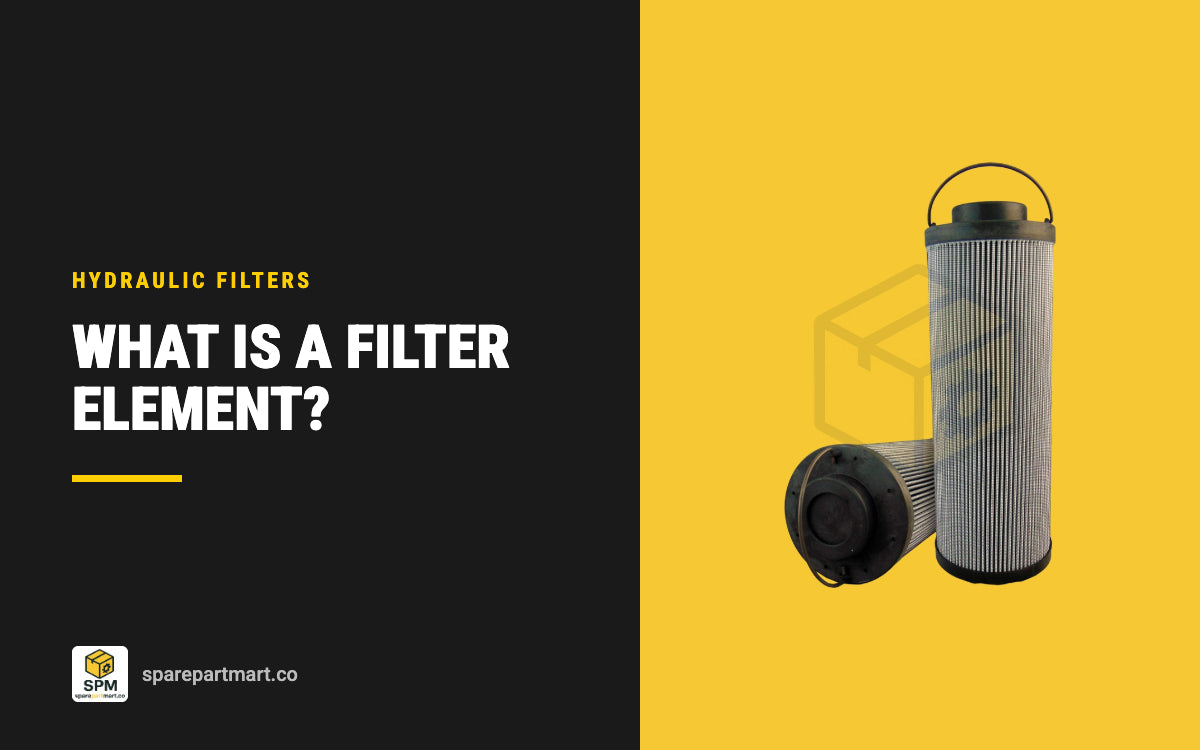
A filter element is the replaceable part of a filter: the pleated cartridge that sits inside a fixed housing and does the actual filtering. In a hydraulic system the housing stays bolted to the machine, plumbed into the suction, pressure or return line, and the element inside it catches the dirt. When the element is full you open the housing, throw the element away (or clean it, if it is wire mesh) and fit a new one. The housing, its bowl and its bypass valve stay where they are.
That is the difference between an element and a spin-on filter. A spin-on is a sealed steel can with the media built in, and the whole can is the replaceable part. An element has no can of its own. It relies on the housing for its shell and its pressure rating, which is why elements are the norm on higher pressure and higher flow hydraulic circuits.
What are hydraulic filters for?
Hydraulic oil carries particles from wear, from the air through the tank breather, and from every hose and fitting opened during a repair. Pumps, valves and cylinders run with tight clearances, so the filter's job is to keep the particle count low enough that those parts wear slowly. A hydraulic circuit can carry filters in three places: a suction filter or strainer before the pump, a pressure filter after the pump to guard valves, and a return filter where the oil goes back to the tank. Each one is a housing with an element inside, and each takes a different element. Our guide on full flow and bypass filtration covers how those circuits fit together.
What is inside a filter element?

Cut a hydraulic element in half and you find five parts.
- Pleated media. The filtering layer, folded into pleats to fit a large surface into a small cylinder. The media decides the micron rating.
- Support core. A perforated steel tube inside the pleats. Oil flows from the outside in on most elements, so the pressure pushes the media inward and the core stops it collapsing. Of the 1,129 hydraulic elements in our catalogue that state a flow direction, 998 flow outside to inside and 131 inside to outside.
- End caps. Steel, aluminium or moulded plastic discs bonded to both ends of the pleat pack. Most elements have one open end where the clean oil leaves and one closed end. Of the 270 elements in our data that describe their construction, 225 are single open end, 14 are double open end and 15 are coreless, meaning the core stays in the housing and the element slides over it.
- Seal. An O-ring or flat gasket on the open end that separates clean oil from dirty oil. Where our listings state the seal material, 228 are nitrile (NBR) and 114 are fluorocarbon (FKM, sold as Viton). HYDAC's element code marks the seal: no letter for NBR, V for FKM.
- Handle or bail. Many return elements have a wire handle on the top cap so you can lift them out of a tank top housing, as on the Hydac 0660 element in the photo above.
Hydraulic filter elements: paper or glass?
Hydraulic element media comes in three families, and all three are on our shelves.
- Glass fibre (also listed as microglass or inorganic microfibre). 868 of the 1,197 hydraulic elements we sell that state a media are glass fibre. Ratings run from 3 to 25 µm. Pall's Ultipor III glass elements, for example, are rated at beta 1000 (99.9% capture) at 2.5, 5, 7, 12 and 22 µm(c) under the ISO 16889 multipass test.
- Cellulose paper (impregnated paper). 124 of ours. They are sold in two ratings only, 10 µm and 25 µm.
- Wire mesh (stainless wire screen). 205 of ours, from 10 to 250 µm, most often 25, 40, 60 and 90 µm. Mesh is the coarse end: suction strainers and protection filters. It is also the only family you can clean. HYDAC's service manual says only its wire screen and metal fibre elements can be cleaned; everything else is replaced.

When you replace an element, match the media and the micron rating the machine maker specified. A coarse mesh element in place of a fine glass one lets far bigger particles past, even though both fit the housing. The Hydac 0660 return element shows how the choice is made: 0660R010BN is glass fibre at 12 µm and 0660R050WHC is wire mesh at 50 µm, yet both are 114.5 mm across, 333 mm long and fit the same housing. Our beta ratio guide explains what the micron and beta numbers on the label promise.
Collapse rating and bypass valves
As an element fills with dirt, the pressure difference across it rises. Every element has a collapse rating: the pressure difference it survives before the pleats or core give way. Our hydraulic elements cluster at four values: 10 bar (194 listings), 20 bar (145), about 31 bar, sold as 450 psid (57), and 207 to 210 bar (132).
The low ratings are for housings with a bypass valve. When the element clogs, the valve opens (3 bar is HYDAC's standard bypass setting) and oil flows around the element, so the element never sees more than a few bar. The 210 bar elements are for pressure filters with no bypass, where the element has to stand the full pressure difference itself. HYDAC states that filters without a bypass, working above 20 bar, need its high collapse elements. Our Hydac 0660D003BH pressure element is one: glass fibre at 5 µm, 93 mm by 331 mm, collapse rated to 210 bar. Fitting a 10 bar return element in that housing would look identical and fail as soon as it loaded up.
How to identify an unknown hydraulic filter element
Most elements can be identified from their part number, which is usually printed on the end cap or the pleat wrap. A single number is enough for us to cross reference it. When the print has worn off, measure these and send them in:
- Outside diameter of the pleat pack and of each end cap.
- Inside diameter of the open end, at the seal.
- Overall length, including any handle or spigot.
- End type: one open end, two open ends, or no core.
- Seal type: O-ring on the outside of a spigot, O-ring inside a bore, or flat gasket.
- Media colour and feel: white or grey glass fibre, brown or yellow paper, or silver mesh.
- The housing's make and model, if it has a plate.
Two measurements narrow the field fast. Across our hydraulic catalogue the middle 80% of elements are 47 to 140 mm in outside diameter and 105 to 480 mm long, with a median of 80 mm by 215 mm. Plenty of different elements share an outside diameter, so the inner diameter and the end type decide the match. Send the numbers through our compatibility check and we reply with the cross references we stock. Brand numbering is a puzzle of its own; the Pall HC code guide and the Fleetguard prefix guide decode two of the common systems.
Element or spin-on: which one does my machine use?
Look at the filter on the machine. If it is a painted steel can that unscrews from a head, with no bowl or cover, it is a spin-on and you replace the can. If it is a cast bowl that unscrews, a tank top cover held by bolts, or an inline housing with a drain plug, there is an element inside. Some housings use both styles across a range, so check the part number on the old filter before ordering. When you change an element, follow our guide on changing a hydraulic element without contaminating the system: release the pressure, keep the dirty side away from the clean side and check the seal before you close the housing.
All our replacement elements are listed in the hydraulic filter collection, searchable by the part number on your old element.
Frequently asked questions
Is a filter element the same as a filter cartridge? Yes. Cartridge and element mean the same thing: the replaceable media part that sits inside a housing. Spin-on filters are the other style, with the media sealed into its own can.
Can I clean a hydraulic filter element and reuse it? Only if it is wire mesh or metal fibre. Glass fibre and paper elements trap dirt inside the media and are replaced, never washed.
Can I fit a finer element than the original? Match the original rating unless the machine maker approves a different one. A finer rating traps more of the dirt in the oil, so expect the element to reach its change point sooner. If your indicator has tripped, read our clogging indicator guide first.
What does out to in mean on an element? It is the flow direction: oil enters through the outside of the pleats and leaves through the core. It is the direction on most hydraulic elements, 998 of the 1,129 in our catalogue that state one.
What if I cannot find my element's part number? Measure the outside and inside diameters, the length, the end type and the seal, and send them with a photo through our quote request. We match by dimensions as well as by number.
