


Pall HC hydraulic element codes: how to read every position
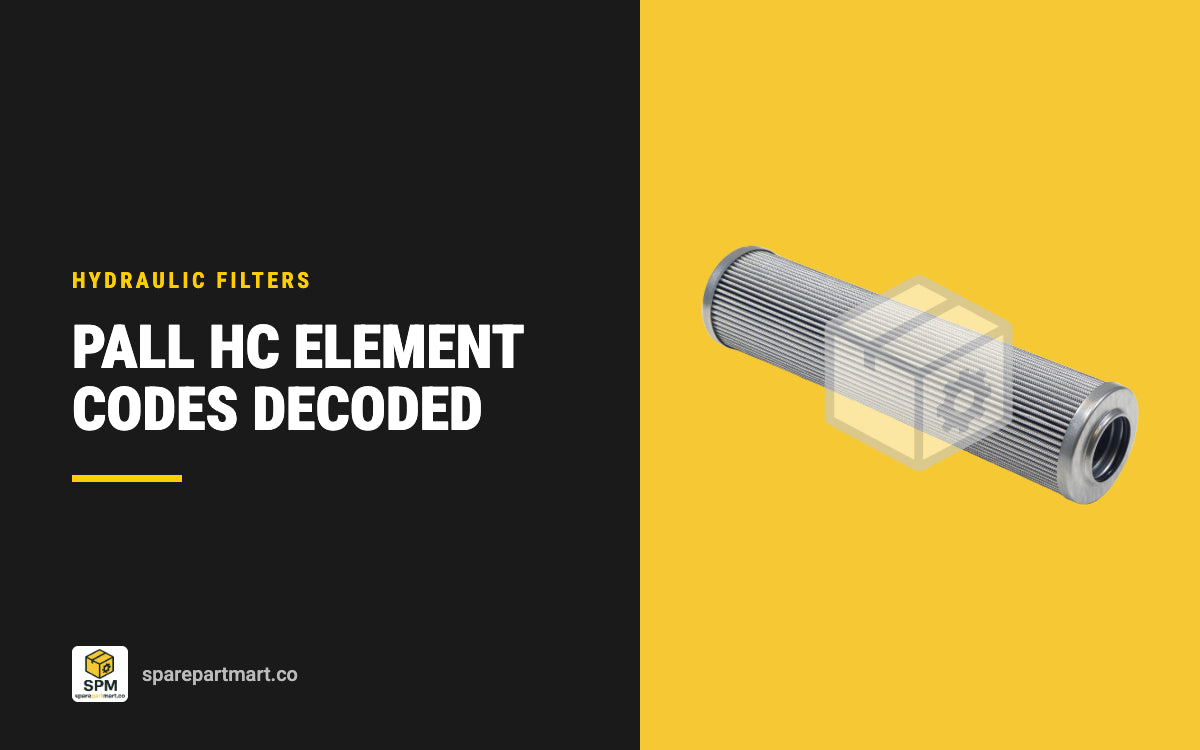
A Pall hydraulic element code such as HC9600FKP16H reads in six parts: HC (a Pall hydraulic or lube cartridge), 9600 (the element series, which sets the housing and diameter), F (a cartridge, not a spin-on), KP (the medium and its grade, here 5 µm(c) at beta 1000), 16 (the nominal length in inches) and H (nitrile seals; Z means fluorocarbon). Read the code left to right and you know which housing it fits, how fine it filters and which fluids its seals tolerate, before you pick it up.
Below: what each position means according to Pall's own data sheets, the trap in the micron figures, and what we see across the 332 active listings on our store that carry a Pall HC code.

Position by position
- HC: Pall's prefix for a hydraulic or lube oil filter cartridge. Every element in our Pall range starts with it.
- Series (four digits): the filter family and housing. 9600, 8300, 8400, 9100 and 2216 are examples. Pall's Ultipor III sheet shows that the last digit can change the construction inside one family: 9600 is the standard element, 9601 the Dirt-Fuse high collapse version and 9604 the coreless version.
- F: a replaceable filter cartridge. Pall uses S in this position for a spin-on can.
- Medium letter: the media family. K is Ultipor III, D is Dirt-Fuse, C is Coralon. More on this below, because it changes the micron figure.
- Grade letter: Z, P, N, S or T, from finest to coarsest.
- Length (number): the nominal length in inches. 8, 13, 16 and 26 are the most common on our store.
- Seal letter: H for nitrile, Z for fluorocarbon (FKM).
- Anything after the seal letter: an option code. On the 0101 series, Pall's sheet lists Y514 as a larger bore, 3.16 in instead of the standard 2.56 in. Option codes are specific to a series, so look them up for that series rather than reading them across.
One letter can appear twice in a code and mean two things. In HC9100FCZ8Z the first Z is the grade (the finest) and the last Z is the seal (fluorocarbon). Position decides the meaning, not the letter.
The grade letter and its micron rating
The grade letter sits right after the medium letter. Pall rates its grades with the ISO 16889 multi-pass test at beta 1000, which means 999 of every 1,000 particles at that size are stopped. If beta ratings are new to you, our guide to hydraulic filter beta ratios explains the test.

- Z: 2.5 µm(c) in Ultipor III, 3 µm(c) in Coralon. The finest of the five.
- P: 5 µm(c) in Ultipor III, Coralon and Dirt-Fuse.
- N: 7 µm(c) in Ultipor III and Coralon.
- S: 12 µm(c) in Ultipor III and Coralon.
- T: 22 µm(c) in Ultipor III and Coralon, 15 µm(c) in Dirt-Fuse.
The Dirt-Fuse T is the one to watch. DT and KT share a letter but not a rating: 15 µm(c) against 22 µm(c). If you change a DT element for a KT, you are fitting a coarser element even though the grade letter is the same.
The P, N, S and T grades account for almost all of our listings: 89 S, 86 P, 81 T and 72 N, with only 4 Z. The four HC9104 8 inch elements show the grade letter in isolation, because everything else in the code is identical: HC9104FCP8H, HC9104FCN8H, HC9104FCS8H and HC9104FCT8H fit the same housing and differ only in how fine they filter.
Why you will see 3, 3.8 and 5 µm for the same KP element
Search an HC code online and you will often find different micron figures for the same part. The element has not changed. The rating method has.
- Older Pall literature: the 1997 sheet for the 0101 series rates KP at 3 µm, KN at 6 µm and KS at 12 µm, at beta greater than 200, under the older ISO 4572 test.
- Current Ultipor III sheet, beta 200 column: KP 3.8, KN 5.7, KS 9.7, KT 18.2 µm(c).
- Current Ultipor III sheet, beta 1000 column: KP 5, KN 7, KS 12, KT 22 µm(c).
So a seller who copied an old catalogue says KP is 3 µm, and one who copied the current sheet says 5 µm(c). Both describe the same media. When you compare two elements, compare the grade letter and medium letter first, and only compare micron figures when both are quoted at the same beta value under the same standard.
The medium letter: k, d and c
Across the 332 active listings on our store with a Pall HC code, 274 carry K, 38 carry D, 19 carry C and 1 carries U.
- K (Ultipor III): the standard glass fibre medium. Collapse ratings on Pall's sheet are 20 bar (290 psid) for pressure line elements and 10 bar (150 psid) for return line elements.
- D (Dirt-Fuse): the high collapse version, rated to 207 bar (3,000 psid) on the same sheet. Pall's Coralon sheet puts high strength elements in the same 210 bar class and specifies them for filters without a bypass valve, where the element must hold even when fully loaded. The Ultipor III sheet rates Dirt-Fuse in P and T grades only. Other D codes exist, such as HC9600FDS13H, so do not assume a D grade carries the K figure.
- C (Coralon): Pall's newer medium. Its 2022 data sheet says the C replaces U, D, K, M or X in an existing code to upgrade to Coralon in the same housing, with the example HC9600FKP8Z becoming HC9600FCP8Z. An A in the same position means the anti-static version.
That substitution rule matters when you cross-reference. HC9100FKZ8Z and HC9100FCZ8Z fit the same housing, in the same grade, with the same seal. One is the older medium and one is the newer. Codes also keep moving: Pall's own web shop lists HC9100FCP13H as replaced by HC9100FRP13Z. If your code does not match a listing, try the code with the medium letter swapped before you assume the element is unavailable.
What you must not swap freely is K for D, or C for D, in a filter without a bypass valve. The Dirt-Fuse rating is there because that housing needs it.
The length number is nominal, not a measurement
The length is a nominal length in inches, and it is close to the real height for some series and not for others. From the drawings for our Pall listings:
- Length 8: 206.6 to 209 mm overall across HC8400, HC8500, HC9020, HC9100 and HC9104.
- Length 13: 327.2 to 333 mm across HC9100, HC9104, HC9600 and HC9901.
- Length 16: 371 to 372 mm on the coreless HC8314FCS16H and HC8304FKN16H, but 426.5 mm on HC9600FCT16H.
- Length 26: 648 to 658.9 mm across HC6400, HC8400, HC9400 and HC9901.
The same number 16 means two heights 54.5 mm apart in two series. When you are checking an element against the old one, measure the overall height, outside diameter and bore, and compare them with the drawing on the product page. Do not multiply the length code by 25.4 and call it done.
The seal letter: h or z
On our store, 239 Pall coded listings carry H (nitrile) and 93 carry Z (fluorocarbon). Pall's sheets give nitrile seals a range of minus 43 °C upwards, and recommend fluorocarbon seals for industrial phosphate esters, diesters and specified synthetic fluids. Both are limited to 60 °C in water based fluids.
If the system runs mineral oil, H is the normal choice. If it runs a phosphate ester fire resistant fluid, Pall specifies fluorocarbon, so the code needs Z. Check the fluid before you order, not after the element is in.
Reading a code off a used element
Pall prints the part number on the bottom end cap of the element. Wipe the cap clean before you read it, because oil and varnish hide the medium letter easily. Then:
- Write the code out in full, including anything after the seal letter.
- Split it into the six positions above and check each one makes sense: a four digit series, F, a medium letter, a grade letter, a number and H or Z.
- Measure the old element's height, outside diameter and bore.
- Search our Pall range by the full code, then by the code with the medium letter changed if the full code does not appear.
Our guide to changing a hydraulic filter element covers fitting once you have the right part.
Frequently asked questions
Is HC9600FKP16H the same as HC9600FCP16H? Same series, grade, length and seal, so they fit the same housing at the same 5 µm(c) grade. The K is Ultipor III and the C is Coralon, which Pall supplies as the upgrade for the K code.
What does the Z at the end of a Pall code mean? Fluorocarbon seals. A Z straight after the medium letter, as in FCZ or FKZ, is the finest grade instead.
Can I fit a coarser grade to make the element last longer? It will fit, but the system will run dirtier. The grade sets the cleanliness the machine was specified for, so keep it unless you have oil analysis showing a different grade is right.
The code on my element has letters after the H. Do they matter? Yes. They are option codes, such as a different bore. Include them when you search, or send us the full code and the measurements and we will match it.
Browse all hydraulic filter elements, or check a code on our compatibility page.
