


Thermostatic valve: why is it needed in a screw air compressor?
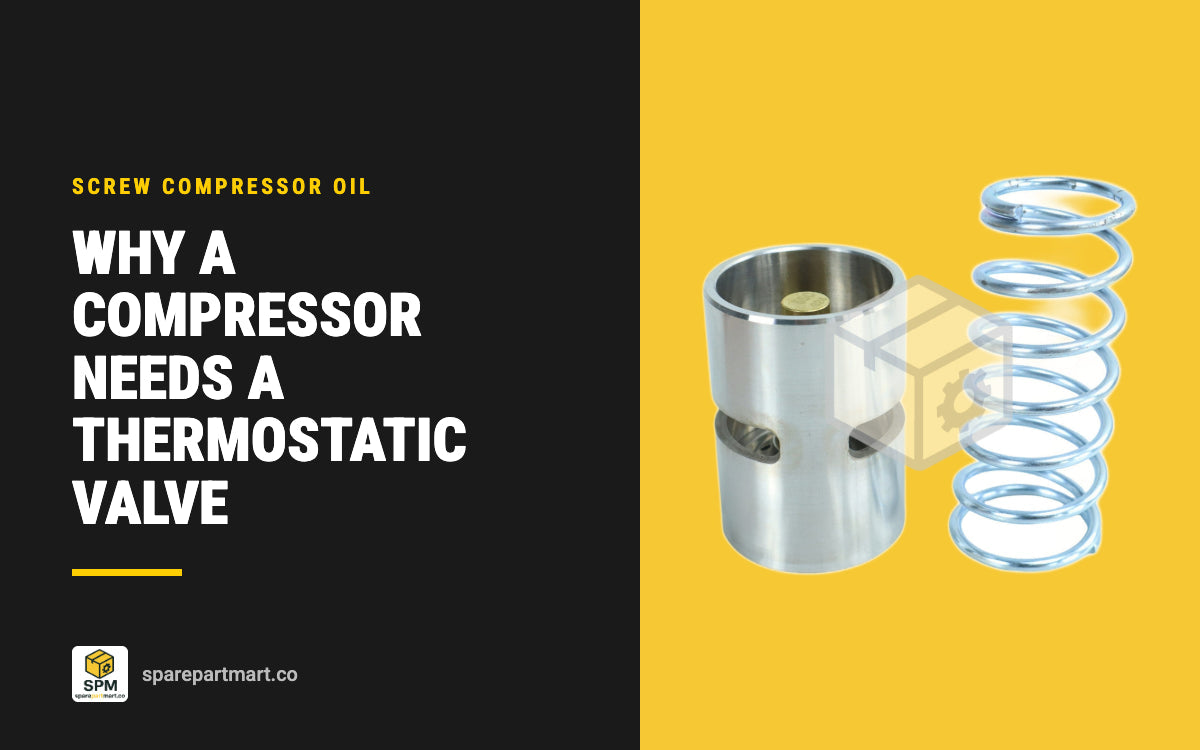
A screw compressor needs a thermostatic valve because its oil has to run inside a narrow temperature band: warm enough that water in the compressed air never condenses into it, and cool enough that it does not cook. The valve does that by deciding how much oil goes through the oil cooler. When the oil is cold it sends it straight back to the air end so the machine warms up quickly. As the oil reaches the valve's rated temperature it opens a path through the cooler and mixes cooled and uncooled oil to hold that temperature. Take it out, or let it stick, and you get either water in the oil or a high temperature shutdown.
Below is how the valve works, why the rating on it matters, what a failing one looks like, and answers to the other questions people ask about it.
What the thermostatic valve does in an oil-injected screw compressor
In an oil-injected screw compressor the oil does three jobs at once: it seals the gap between the rotors, lubricates the bearings and carries away the heat of compression. After it leaves the air end with the air, the separator tank strips it back out, and the thermostatic valve is the first thing it meets on the way back. Air Best Practices describes it the same way: the valve is the first stop after the sump, and on many machines it is built into the oil filter housing.

Inside the valve is a wax element in a slotted sleeve, held closed by a return spring. Wax expands as it melts, so as the oil passing over it warms past the element's rating, the element pushes the sleeve against the spring and uncovers the port to the cooler. Below the rating, all the oil bypasses the cooler. Above it, the oil is split between the two paths so the mixed temperature stays close to the rating. Nothing electrical is involved; the valve works on oil temperature alone.
Most of the 43 thermostatic valve listings in our compressor thermostatic valve range are exactly this part: the wax element and sleeve with its spring, sold as a kit to drop into the existing housing. A few are screw-in elements on a hex plug, such as the Ingersoll Rand 39441944 element, and two are complete valve bodies with the element already fitted.
Why it is needed: water below, varnish above
The air a compressor draws in carries water vapour. Compression concentrates it, so the air in the separator tank is far wetter per cubic metre than the room it came from. If the oil and air in that tank are cooler than the pressure dew point, the water condenses into the oil. Atlas Copco's patent on preventing condensate in oil-injected compressors sets out the rule plainly: the valve's set point has to be high enough that the air in the oil reservoir never reaches its condensation point in any operating condition. Air Best Practices links water building up in the sump directly to low oil temperature.
Water in compressor oil means milky oil, rust inside the tank and air end, short oil life and damage to the parts the oil is meant to protect. A machine without a working thermostatic valve, with all the oil going through the cooler all the time, runs cold enough to collect water whenever the room is cool or the load is light.
The other side is heat. Oil that runs too hot loses its additives faster, the base stock turns acidic, and the acid leaves varnish on valves, coolers and filters. The cooler is there to stop that, and the thermostatic valve is what brings it in once the oil is warm. So the valve is not an optional extra on the cooler. It is the part that makes the cooler work at the right moment.
Why thermostatic valves come in different temperature ratings
The rating is the temperature at which the element starts to open to the cooler, and it is chosen by the compressor maker for that machine and its oil circuit. Atlas Copco alone sells inserts in one family at 38 °C, 60 °C, 71 °C, 75 °C and 87 °C (part numbers 1622706401, 1622706404, 1622706405, 1622706403 and 1622706407). In our own listings the stated opening temperatures run from 38 to 71 °C:
- 38 °C: Atlas Copco 1622706401
- 40 °C: Atlas Copco 1622375980, 2901-1454-00 and 2901-1616-00
- 60 °C: Atlas Copco 1622706404 and 2901-1464-00
- 65 °C: the Atlas Copco 1619759600 element, used on Atlas Copco screw compressors under 30 kW
- 70 °C: CompAir A11175374
- 71 °C: Gardner Denver 100010137
Two elements can look identical and fit the same sleeve but open at different temperatures, so never pick one by size alone. The rating is usually stamped on the brass end of the wax element: our photo of the Atlas Copco 1202586905 kit for the GA26 to GA90 shows it clearly. Fitting a lower rating than the machine was built for makes it run colder and collect water; fitting a higher one makes it run hotter and age the oil. Order by the part number on the old element or in the parts manual, and if your site is humid and the oil keeps showing water, talk to the compressor maker about the rating before swapping in a different one.
Does the thermostat control the compressor?
No. The thermostatic valve only steers oil between the cooler and the bypass. It does not start, stop, load or unload the compressor. Loading and unloading are set by system pressure through the controller and the intake valve (our guide to intake valve problems covers that side). Temperature protection is a separate sensor, usually at the air end outlet, that tells the controller to warn and then shut down when the temperature is too high. The thermostatic valve is what keeps the machine away from that limit in normal running, but it has no say in when the shutdown happens.
Signs the thermostatic valve is failing
The wax element can wear out, and the sleeve can seize from varnish or jam on particles in the oil. Which way it sticks decides the symptom.

- Stuck in bypass: the oil never reaches the cooler. The machine runs hot and trips on high temperature, and the cooler stays cool to the touch while the tank is hot.
- Stuck open to the cooler: the oil is always cooled. The machine is slow to warm up, runs at a low temperature, and the oil goes cloudy or you find water at the tank drain.
Rule out the simple causes first. A hot compressor is far more often low oil, blocked cooler fins, a failed cooler fan, a hot room or a clogged oil filter. A cold one is often a light duty cycle or a cold room. Once those are clear, feel the cooler inlet and outlet pipes with the machine warm and loaded: hot in and barely warm out with a hot tank points at the valve. Then pull the element and look for varnish on the sleeve or a sleeve that does not move freely.
When to change it
There is no single hour figure for the element across brands, so check it at every oil change against your machine's service schedule and replace it whenever it shows varnish, a sticky sleeve or a running temperature that has drifted. The oil filter sits right after it in the circuit and is often in the same housing, so it makes sense to change both together. Our compressor oil filter fitting guide covers that job. Fit new O rings with the element, since a leak past the sleeve lets hot oil bypass the cooler even with a good element.
Frequently asked questions
What is the purpose of a thermostatic valve? It holds the oil at a set temperature by mixing cooled and uncooled oil. In a screw compressor that keeps water from condensing in the oil at low temperatures and keeps the oil from overheating at high ones.
Can I run a screw compressor without the thermostatic valve? It will run, but with all the oil going through the cooler it runs cold, and on a cool or humid day water condenses in the oil. Blanking the cooler path instead makes it overheat and trip. Neither is a fix.
Is a thermostatic valve the same as a thermostat? In compressor parts lists the names are used for the same part: thermostat, thermostatic valve, thermal valve, temperature control valve or valve core. They all mean the wax element that switches oil between the cooler and the bypass.
How do I know which thermostatic valve I need? Read the part number off the old element or the parts manual and match it, including the temperature rating. If you only have the machine model and serial number, send them through our compatibility check or request a quote and we will match the element and its rating for you.
