

No Products in the Cart


Oil mist from a vacuum pump exhaust: is the exhaust filter finished?
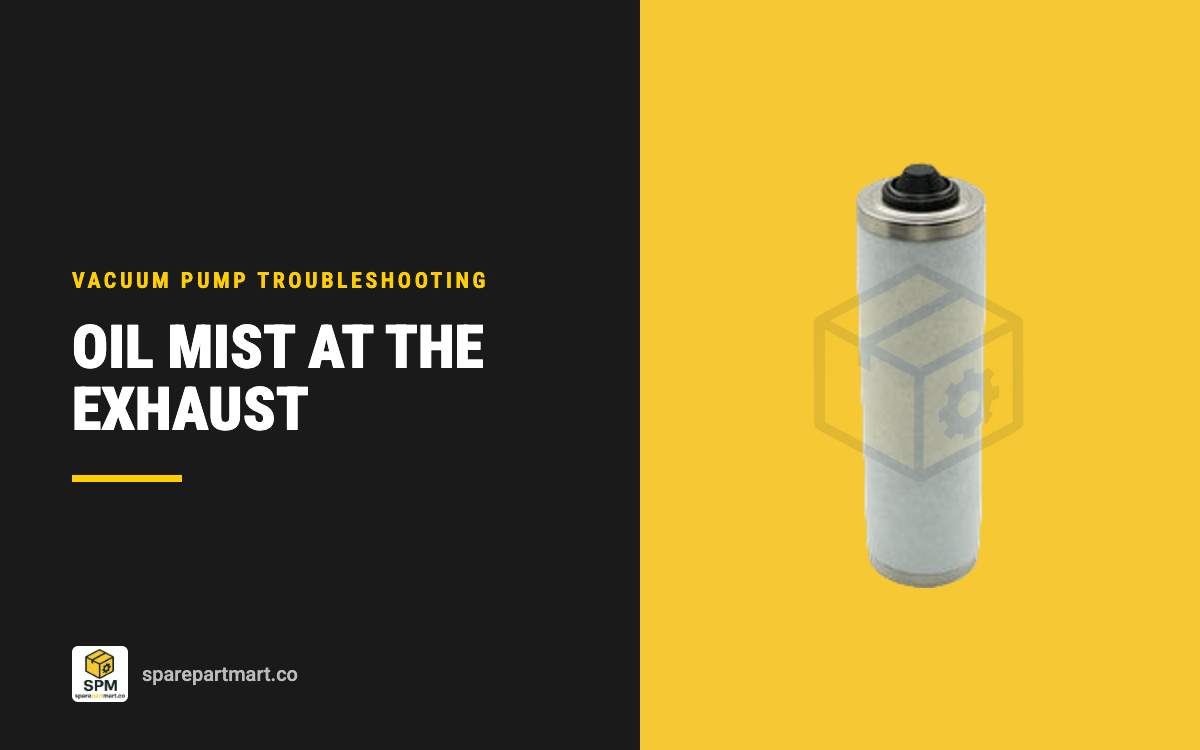
Oil mist coming out of an oil sealed rotary vane vacuum pump exhaust usually means the exhaust filter is saturated, but not always. Busch and Leybold both list three other causes in their troubleshooting tables that give exactly the same mist: an oil level that is too high, a filter that is not sealed on its o-ring, and a blocked float valve or oil return line. A fourth, vapour condensing in the oil, makes mist that no new filter will cure. Check those first, because they cost nothing. If they are all clear and the pump is also using more oil than it used to, the filter is finished and the whole set should be changed.
This guide walks through the checks in the order to do them, then covers how to match the replacement so the new element actually seals.
What the exhaust filter is doing
Oil is injected into the pump chamber to seal, lubricate and cool the vanes, and some of it leaves with the compressed gas. In a Leybold SOGEVAC SV630 B, for example, the oil is first trapped coarsely in the bottom of the oil casing, then the fine droplets are caught by eight exhaust filter elements. The oil they collect drains back to the pump through an oil return line, and a float valve on that line stops gas at atmospheric pressure flowing back into the intake.
So the filter only works if three things are right at once: the element is clean enough to pass gas, it is sealed so the gas cannot go around it, and the oil it catches has somewhere to drain. Mist at the exhaust means one of those has failed, or the pump is throwing more oil than the system was built to handle.
Some pumps add a safety feature that hides a clogged filter. In the SV630 B the elements have an integrated bypass that opens at 1.5 bar absolute. Once the filters clog far enough, gas goes straight past them, the exhaust stops being restricted, and the only signs left are oil in the exhaust gas and oil consumption going up. A pump that runs normally but mists is not proof the filters are fine.

Check 1: the oil level
Start at the sight glass. Leybold's instruction for the SV630 B is that the oil level in operation must sit between the middle and the top edge of the glass, checked at least once a day. Both the Busch R5 and Leybold troubleshooting tables list an oil level that is too high as a cause of oil at the exhaust, and the remedy in both is simply to drain the excess.
Read the level with the pump on a level floor. Overfilling often happens after an oil change where the level was read with the pump cold and then topped up again, or where someone topped up to the top of the glass rather than to the band the manual gives.
Check 2: is the element sealed?
If the mist started straight after a filter change, look here first. Busch lists "exhaust filter with o-ring not fitted properly" as a cause of the pump expelling oil, and the remedy is to correct the position of the filters and their o-rings. The Busch R5 RA 0010 to 0016 C exhaust filter change calls for a new o-ring with every filter, so reusing the old one is a fault in itself.
Leybold adds a second version of the same problem. Its SV630 B manual warns that the exhaust demisters sometimes loosen in shipping and installation, and that a loose demister gives exhaust smoke at start-up and in operation. A pump that has just been moved, delivered or reinstalled should have its elements checked for tightness before anyone orders new ones.
Signs of a sealing fault rather than a clogged filter:
- Mist appears immediately, not gradually over weeks.
- Oil consumption jumps from the first day after the change.
- The old element, when you pull it, is not wet through or heavy with oil.
- The o-ring is twisted, nicked, missing, or still sitting in the housing from the old element.
Check 3: the float valve and oil return
An element can be perfectly good and still put oil out of the exhaust if the oil it catches cannot drain. Busch's table lists "float valve does not work properly" with the remedy to check the float valve and the oil pipe for clogging. Leybold lists a clogged float valve nozzle as a cause of high oil consumption and oil mist, and its maintenance schedule says to check the float valve every time the exhaust filters are changed.
Busch adds one operating condition for R5 pumps fitted with an oil return valve rather than a float: if the pump runs for more than two hours without stopping, the oil does not get a chance to return, and the remedy is to shut it down for short periods regularly. On those versions, mist that only appears on long runs and clears after a stop is an operating pattern, not a filter fault.
A return line blocked by sludge also tells you the oil itself has broken down. Change the oil when you clear it.
Check 4: vapour in the oil
Pumps on drying, packaging, degassing or any process with moisture or solvents can take vapour into the oil. Leybold names two signs: the oil level rising while the pump runs, and oil that has gone turbid. Its remedy is to degas or change the oil, open the gas ballast valve or add a condensate trap, and warm the pump up for about 30 minutes with the intake closed and the gas ballast open before letting vapour in. After the process, it should run for at least 30 more minutes with the gas ballast open and the intake closed until the oil is free of condensate.
Volatile substances also pass straight through an exhaust filter, which is a coalescer for oil droplets and not a vapour trap. If what you see at the exhaust is vapour from the process rather than oil, a new element will not change it. That is a case for an exhaust line, which Leybold says is always necessary when the exhaust gases are dangerous.
Check 5: the filter is clogged
With the oil level right, the elements sealed, the return draining and no vapour in the oil, mist at the exhaust plus rising oil use is a saturated filter. Leybold's maintenance table gives "if oil mist at exhaust" as the trigger to replace the exhaust filters, and says they need replacing more often when the oil cracks at high temperature or the pump handles aggressive media.
A restricted exhaust shows in other ways too. Leybold gives a maximum exhaust pressure of 1.15 bar absolute for the SV630 B, and warns that an exhaust line narrower than the pump's outlet causes overpressure or overheating. Busch sells oil filler caps with an exhaust pressure gauge for this reason. If your pump has one, a reading climbing over the weeks is the clearest early warning you will get.
Replace every element on the pump at once, with a new o-ring on each, and check the float valve while the housing is open. Busch's maintenance schedule changes the oil, the oil filter and the exhaust filters together, so if the oil service is close, do it in the same stop.
Matching the replacement: length is the trap
We list 302 vacuum pump exhaust filters as of 1 November 2026, sold under the product type Separator: 131 Busch, 27 Leybold, 17 Becker, 16 Elmo Rietschle, 7 Edwards, 7 DVP and 6 Pfeiffer listings, plus the same elements under Mann, Sotras, Noitech and other filter maker numbers. Our catalogue data shows how easily the wrong one fits.

Six Busch exhaust filters in our catalogue share the same 72 mm outside diameter and 35 mm bore. Only the total height separates them: 140 mm for the Busch 0532000510, 208 mm for 0532000512, 220 mm for 0532127416, 258 mm for the Busch 0532000222, 383 mm for 0532000508 and 507 mm for the Busch 0532000507. A short element will push onto the spigot and seal on its o-ring, so the pump runs, but there is less media to pass the gas and it saturates sooner.
Becker does the same. The Becker 965416 and 965415 are both 101 mm outside and 63 mm bore, at 251 mm and 293 mm tall. The 965404, 965413 and 965414 share 65 mm by 43 mm and run 100, 103 and 145 mm.
Before you order:
- Read the part number on the old element's end cap and match it, not the pump model alone.
- If the label is gone, measure the outside diameter, the bore and the total height in millimetres, and send them with the pump model and serial plate through our compatibility check.
- Count the positions. The SV630 B takes eight elements; small Busch R5 pumps take one or two.
- Order the o-rings with the elements if they are not included.
The full range is in the separator collection. If you are servicing the pump at the same time, the inlet filter troubleshooting guide covers the other end of the pump, and the vane wear guide covers what to measure while it is open. For an element you cannot find by number, use our quote request.
Frequently asked questions
Can I clean and reuse a vacuum pump exhaust filter?
No. Both the Busch and Leybold troubleshooting tables give one remedy for a clogged or damaged exhaust filter: replace it.
The mist started the day after I changed the filter. Is the new one faulty?
Check the seating first. A twisted or reused o-ring, an element not pushed fully home, or a loose element nut gives mist straight away. Busch lists an incorrectly fitted filter and o-ring as a cause in its troubleshooting table.
Why is my pump using so much oil?
Leybold's manual says high oil consumption often indicates clogged exhaust filters. On pumps with a bypass, a clogged element is skipped and oil leaves with the gas. Check the level and the float valve as well.
Do I need to change all the exhaust filters if only one position is misting?
Yes. They have run the same hours on the same oil. Changing one leaves the others close to the end, and the next stop comes sooner.
Will a new exhaust filter stop solvent smell at the exhaust?
No. Volatile substances pass through the filter. That needs an exhaust line to a safe point, or a process change, not a new element.
