

No Products in the Cart


How long an excavator cab blower motor lasts, what wears it out and the signs it is due
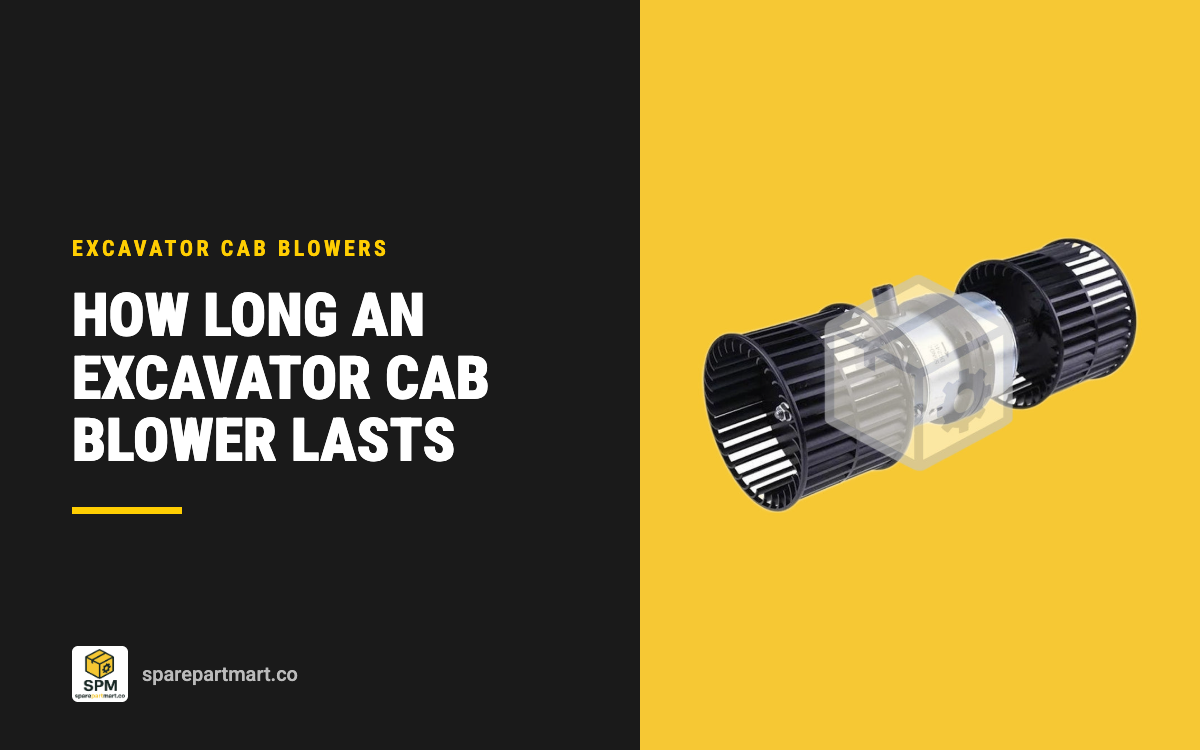
No excavator maker publishes a service life in hours for the cab blower motor. Caterpillar's 320C maintenance interval schedule has no blower entry at all: the blower appears in the fuse list, not the schedule, and the cab filters that protect it are serviced "when required". The blower is a run-to-condition part. How long yours lasts depends on four wear points: the fan wheel, the motor bearings, the brushes and commutator inside the motor, and the plug. Dirt, high current, heat, humidity and silicone vapour shorten its life. Clean filters, a clean case and a sound plug lengthen it. Weak air, a squeal that follows fan speed, grinding, a blown fuse or a dead fan at every speed are the signs it is due.
Why there is no hours figure
Caterpillar's operation and maintenance manual for the 320C lists the recirculation filter and the fresh air filter under "when required", the air conditioner belt every 250 service hours, and the receiver dryer every 2,000 service hours or one year. The blower motor has no line of its own in the schedule. It does appear in the fuse chart, where the heater and air conditioner blower fan has its own 15 amp fuse.
That matches how the part behaves. A cab blower runs whenever the operator wants air, at whatever speed the operator picks, in whatever dust and weather the site has. Two machines with the same hour meter reading can have blowers in very different condition. So the useful questions are what wears it, what speeds that up, and how to see the end coming before it stops on a hot day.
Where a blower motor wears
Every blower in our excavator blower motors range is a 24 V motor with its fan wheel fitted, sold as one unit. Whether it is the single wheel Caterpillar 178-5484 for the 307C to 320C (see current price) or the twin wheel Caterpillar 229-9137 for the 308C to 328D LCR, the same four places wear.
- The fan wheel. The squirrel cage wheel moves the air. Dust that gets past the filters builds up on its blades, and a blade that catches debris can crack or break.
- The bearings. The motor shaft runs in bearings at each end. They carry the weight of the wheel and any imbalance in it, and they are where most of the noise comes from as a blower ages.
- The brushes and commutator. In a brushed motor, carbon brushes press on a copper commutator to feed current to the spinning armature. Friction and electrical erosion wear the brushes down, and as the springs behind them weaken, contact falls off and sparking increases. Sparking damages the commutator bars.
- The plug and wires. The plug carries the full motor current. A loose or corroded pin makes heat, and brown or melted plastic on the connector shows it has been running hot.

What shortens a blower's life
Dirt in the air stream. This is the one the machine makers write down. Caterpillar's 320C manual warns that a recirculation filter plugged with dust decreases the performance and the service life of the air conditioner or cab heater. Premium Guard, a cabin filter maker, puts the mechanism plainly: without a filter, dirt builds up on the fan blades and inside the motor housing, which can overheat the unit and knock the fan off balance, and eventually the blower fails. Running with a filter missing or torn is the fastest way to shorten a blower's life.
Current. A 2023 study of graphite motor brushes from Hanoi University of Science and Technology, published in Tribology in Industry, tested brush wear under changing current, temperature and humidity. It found that service life depended on current more than on humidity or temperature. On a resistor system, the top fan speed sends the most current through the motor. A blower that spends every shift on full speed is working its brushes harder than one that runs on a middle setting.
Heat and humidity. The same study found temperature and relative humidity clearly affect brush wear, and it was written for humid tropical conditions. A machine working through a wet summer, or one parked outside in a humid climate, puts more wear on its blower than one in a dry, mild one.
Silicone and fine particles. Motion Control Tips, a motor engineering publication, lists too much particulate and silicone among the causes of brush wear, and notes silicone causes extremely rapid brush wear. On recirculation, the blower draws cab air straight through the motor. Silicone dash and trim sprays used inside the cab end up in that air. Wipe-on products used away from the vents keep it out of the motor.
A neglected plug. A connection running hot gets worse, not better. Once the plastic browns, the pins have lost their grip and resistance climbs. Fitting a new motor to a burnt plug half on the machine side repeats the failure.
A bigger fuse. Caterpillar says to replace a fuse only with one of the same type and capacity, and to check the circuit if a new fuse blows. A larger fuse in the blower circuit lets a jammed motor or a wiring fault keep drawing current that the correct fuse would have cut.
Signs your blower is due
HELLA, which makes interior blowers for cars and commercial vehicles, lists the signs that a blower needs replacing: poor or weak airflow, grinding, rattling or whistling noises, a motor that stops completely, speed problems, uneven airflow between vents, and electrical faults such as blown fuses. Some of these point at the motor and some point elsewhere, so read them in order.
- Weak air at every speed. Check the recirculation and fresh air filters before blaming the motor. On the 320C both can be cleaned with air at no more than 200 kPa (30 psi), and Caterpillar says to fit a new element if one is damaged or badly contaminated. If the air is still weak with clean filters, look at the wheel for dirt or broken blades.
- Air on high only, or missing speeds. HELLA names the motor, the resistor and the control module as the possible causes when the speed control does not work properly. A motor that runs at any speed is turning, so test the resistor first.
- A squeal that rises and falls with fan speed. This is the bearings. It is the early warning: the blower still works, but it is time to order the replacement and change it at the next service.
- Grinding or rattling. Grinding means the bearings are close to seizing. A rattle can be debris in the case or a broken blade. Either way, change it now, before a seized motor takes the fuse with it.
- A tick that follows fan speed. The wheel is touching the scroll, or something is lodged in the case. Clean it and recentre the blower on its flange.
- The blower fuse blows. A jammed wheel, a seized motor and a wiring fault all do this. Find which before fitting a new fuse.
- No air at any speed, with a good fuse and the fan control on. The motor has stopped. This is the case where a new blower is the fix.

How to get more life from the next one
Keep the filters in and clean. Check the recirculation and fresh air filters whenever the machine works in dust, and never run with one missing. Caterpillar's 320C manual puts the recirculation filter on the lower left side of the cab and the fresh air filter behind the cab, with the arrow on top facing forward. The recirculation element must be dry before it goes back.
Clean the case when you change the blower. Leaves, dust and broken blade pieces left in the scroll go straight into the new wheel. Our blower fitting guide covers cleaning the case, seating the flange flat and spinning the wheel by hand before first start.
Use the middle speeds. Full speed is there when the cab needs it. Since brush life depends most on current, a blower that spends most of its hours below the top setting wears more slowly.
Keep silicone out of the air stream. Apply cab dressings to a cloth, not into the air near the vents, and let the cab air out before you switch to recirculation.
Look after the plug. When the panel is off for a filter, check the blower plug is latched and the plastic is clean. Replace a browned plug half straight away.
Act on the squeal. A squealing blower still moves air, so it is easy to leave. Ordering when you first hear it means the change is done on your schedule rather than when the bearings seize.
Which blower fits your machine
Match by the part number on your old blower or in the parts manual. Our range covers the Caterpillar 245-7839 with its own plastic housing for 311D to 330D and 345C excavators (see current price), the twin wheel Hitachi 4475716 for ZX60 to ZX225US machines, the Hitachi XB00001057 for Zaxis -5G machines, the Hitachi 4370266 for EX100-5 to EX200-5, and the Doosan 300506-00988, also sold as K1002206, for DX140W to DX340LC. Our compatibility page explains how to match a part from its number. For the sensors and switches that age alongside the blower, see our heavy equipment engine parts.
Frequently asked questions
How many hours does an excavator blower motor last?
No maker publishes a figure, and Caterpillar's 320C schedule has no blower interval. It is replaced on condition. Filter care, fan speed habits, climate and the state of the plug decide how long yours runs.
Should I change the blower at a set interval anyway?
No. Change it when it shows the signs: a squeal that follows fan speed, grinding, weak air with clean filters, or no air at any speed with a good fuse. A blower that runs quietly at every speed is doing its job.
Can a clogged cab filter kill the blower motor?
It shortens its life. Caterpillar warns that a recirculation filter plugged with dust decreases the service life of the air conditioner or cab heater, and a missing filter lets dirt build up on the fan blades and inside the motor housing.
Does running the fan on full speed wear it out faster?
Yes. Brush wear depends on current more than on temperature or humidity, and the top fan speed draws the most current. Use full speed when you need it, not all day by habit.
My part number is not in your range. Can you find it?
Send us the number and the machine model through our request a quote page and we will look for a matching blower.
